
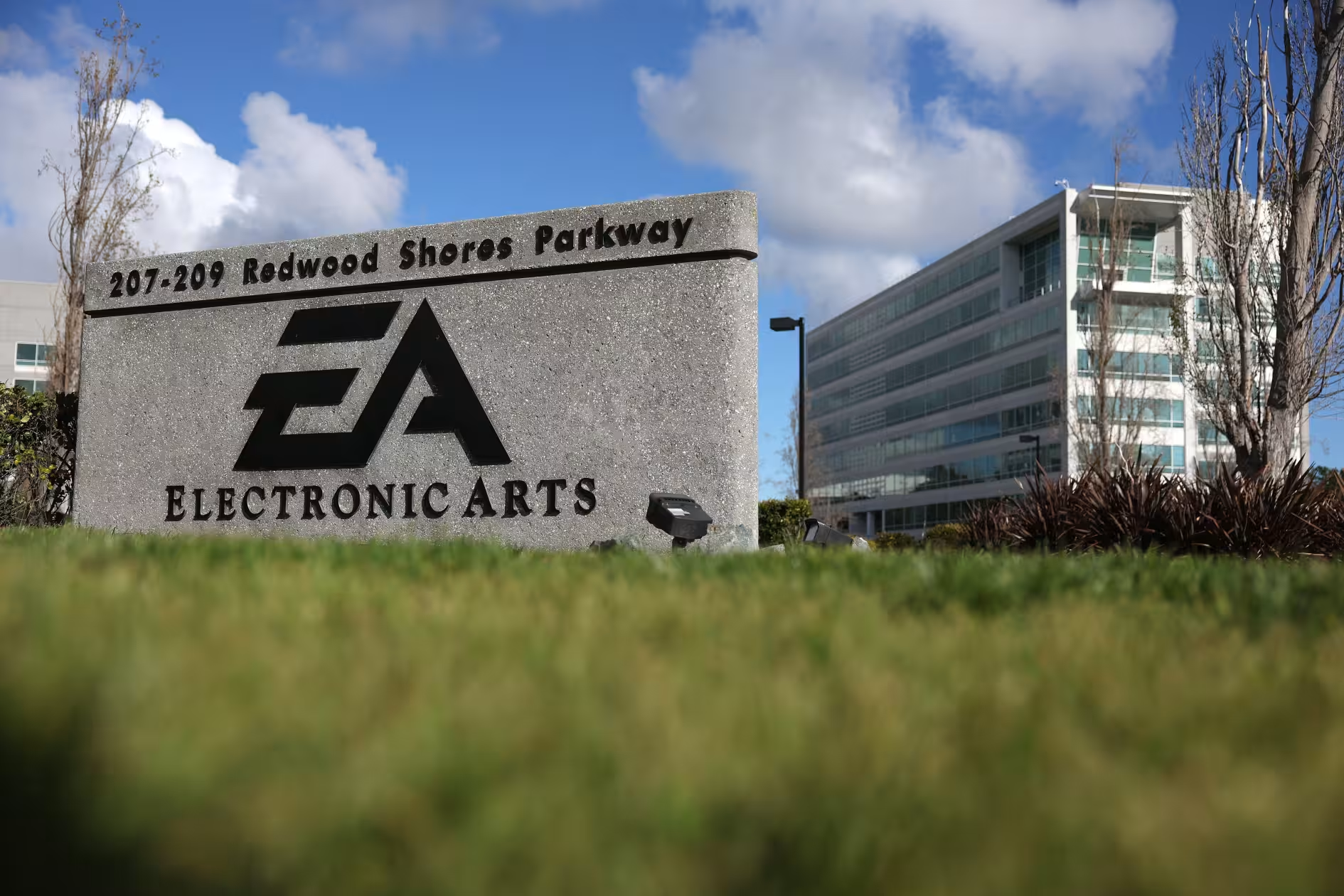
The biggest leverage buyout in history isn’t oil, energy or telecom – it’s video games.
If you’ve picked up any financial publication in the last week, you’ve likely heard about the latest mega deal coming out the world of Private Equity. In late September 2025, Electronic Arts (EA), the video game behemoth behind EA FC, Madden, and The Sims, agreed to a $55 billion all-cash take private. The deal is being completed by a consortium of investors, led by Saudi Arabia’s Public Investment Fund (PIF), alongside Silver Lake, and Jared Kushner’s Affinity Partners.
The acquisition is a landmark of its kind. Not only does it surpass the 2007 TXU deal as the largest LBO in history, but it also takes the model to a truly global scale, driven by Saudi sovereign wealth. It marks one of the largest acquisitions of a U.S. company by a foreign investor in recent years, underscoring the consistent investment we’ve seen from the middle east into the west. With considerably less leverage that the mega-buyouts of the 2000s, the transaction also signals a shift in the PE landscape towards more equity heavy deals, funded by deep-pocketed investors.
In this blog, we’ll break down how the deal came together, why it fits perfectly within Saudi Arabia’s broader investment strategy, what makes EA a textbook PE candidate, and yes, how even this story has its own AI angle.
Inside the Deal: Who’s Behind EA’s Record-Breaking LBO
As you’d expect, the biggest LBO in history has a lot of moving parts. So let’s start by breaking down who’s involved in the deal and how it came together.
At the centre of the consortium sits the Public Investment Fund (PIF), Saudi Arabia’s sovereign wealth vehicle and one of the most active global investors of the past decade. With assets under management over $900 billion, the fund has made substantial investments across sectors ranging from technology to sport. Notable examples include its acquisition of Newcastle United in 2021 and its funding of LIV Golf.
The next major player is Silver Lake, a standout name in private equity technology investment. Founded in 1999, Silver Lake has backed companies such as Dell Technologies, Airbnb, and Skype, earning a reputation as one of the most successful technology-focused private equity firms in the world. Its involvement in the EA deal brings operational expertise, deep industry knowledge, and a proven track record in scaling global digital businesses.
The third member of the consortium, Affinity Partners, is a relatively new entrant. Founded by Jared Kushner, the son-in-law of U.S. President Donald Trump, the firm was established in 2021 after the end of the sitting presidents first term. PIF was among its earliest and largest financial backers. Since its launch, Affinity has positioned itself as a connector between Middle Eastern capital and Western markets. Its participation in this deal likely played a key role in securing PIF’s substantial commitment of capital
Being a leveraged buyout, the deal is structured using a mix of both debt and equity. Roughly $35 billion in equity will be provided by the consortium, while the remaining $20 billion will be financed with debt. This means that only about one third of the acquisition value is funded by borrowing, which is unusually low for a transaction of this size.
The deal came together with striking speed. Informal discussions began in early 2025, supported by the 9.9% stake that PIF already held in EA. By late August, the consortium had been formed and submitted an initial bid to the EA board, reported to be around $48 billion, which was rejected. A revised offer of $55 billion followed only weeks later. This left the group needing a lender that could provide a rapid $20 billion credit line, and few institutions could move faster than J.P. Morgan. The bank completed due diligence in under three days before committing to the full debt package. By the start of October, the agreement had been finalised and announced publicly, an extraordinary pace for a deal of this scale and complexity.

Saudi Arabia’s Strategic Play
Saudi Arabia’s involvement in this deal is about far more than ownership of a gaming company. For PIF, it represents another step in a long-term plan to transform Saudi capital into global influence.
This latest splash of Saudi cash aligns with their Vision 2030, Saudi Arabia’s plan to shift away from hydrocarbons and build lasting growth through sectors like technology, sport, and entertainment. PIF has already invested billions across these areas, with the acquisition of EA being another step in this direction.
Investment in gaming, however, brings something many more traditional sectors can’t: cultural reach. With over 3 billion players worldwide, video games are an extremely powerful vehicle for gaining soft power and influence, especially over younger generations. Saudi Arabia sees this industry not only as a source of consistent returns from its rapid growth, but as a chance to position the kingdom as a global hub for gaming. It has been building a steady presence in this area for some time through PIF’s gaming subsidiary, Savvy Games Group, with investments in Nintendo, Take-Two, Scopely, and now EA.
Another benefit that can’t be overlooked is reputation. In recent years, Saudi Arabia has gained somewhat of a reputation for being the new “dumb money,” seemingly willing to throw cash at any deal within reach. This transaction, however, shows that the kingdom is moving beyond that label. EA, along with their other gaming investments, reflects a more deliberate approach, Saudi capital being placed strategically in assets that can sustain growth and diversify the nation. Working alongside a powerhouse in private equity like Silver Lake, and having J.P. Morgan confidently underwrite the debt, further reinforces that point. The willingness of such established institutions to partner with PIF signals that Saudi money is now viewed as serious, strategic, and sophisticated.

Why EA Is a Private Equity Dream Come True
If there’s one thing PE loves for an LBO, it’s a company that can generate consistent predictable cashflows, and in the gaming space there are few who can match EA on that front. With franchises like EA FC and Madden having new releases every year, EA benefits from a loyal, recurring customer base that reliably drives revenue each year. Combined with major titles such as Battlefield and The Sims, the company’s EA Play subscription service, and steady income from in-game purchases, EA has consistently produced between $5 and $7 billion in annual revenue over the past five years. It’s this level of stability that makes EA such a good candidate for an LBO, as the predictable stream of cash provides plenty capital that can be used to service the debt from the buyout, without straining the company.
The consortium behind this deal will also be eyeing up the likely cost-cutting opportunities within EA. First off, by going private, the company can strip back the costly and time-consuming reporting requirements that come with being public. This will free up management to focus on innovation and long-term growth, rather than constantly chasing quarterly results to keep shareholders happy.
Then there’s the AI angle. As a major video game producer, EA is well-placed to take advantage of emerging AI technology to speed up processes and cut labour costs. Right now, things like character design, coding, and animation are handled by large teams of designers, artists, and engineers. If AI can automate or even partially reduce the manual side of these tasks, EA could significantly lower costs while boosting efficiency.
All in all, with strong and reliable revenue generation alongside clear cost-cutting potential, EA has all the right ingredients for a successful LBO.

A Shift In LBO Dynamics?
More broadly, this deal reflects a shift in how LBOs are being structured. As mentioned, only around $20 billion of debt is being used to finance this deal, roughly 36% leverage. That’s a notable change from the 70%+ levels commonly seen in the past. So, what’s changed?
In the U.S., interest rates have remained elevated since the post-COVID inflation spike, only now starting to edge down from the 5% range over the past year. Higher rates make servicing debt more expensive and, in turn, increase the pressure on companies taken private through LBOs. As a result, heavy leverage has become less attractive than it once was.
At the same time, there’s a wall of “dry powder”, capital that funds have yet to deploy. Estimates suggest there’s over $2.5 trillion in uninvested capital globally within PE funds alone. When you add sovereign wealth funds such as PIF into the mix, there’s a huge amount of cash waiting to be invested. Because of this, funds appear increasingly willing to commit more equity to deals in order to put their capital to work.
This shift in LBO methodology can be illustrated clearly when we compare this EA LBO with the buyout it’s surpassing as the biggest ever, TXU.
TXU was a Dallas-based energy company that was bought out for $45 billion dollars in 2007. The deal was funded with approximately $36 billion of debt, 80% leverage. The buyers had assumed that natural gas prices would remain high and TXU would be able to capitalise on rising energy demand. However, the opposite occurred as shortly after the deal. Natural gas prices plummeted, and so too did TXU’s expected profits. The company was left drowning in debt and went bankrupt in 2014.
By contrast, EA’s $55 billion take-private carries only about 36% leverage and is backed by deep, long-term equity from its investors. Whereas TXU relied on cyclical commodity prices, EA’s cash flows come from stable digital revenues and strong franchises.
The contrast between the two deals says it all. One was banking on cheap debt and optimism, while the other is backed rock solid revenue and a sensible debt burden

Final Thoughts
EA’s $55 billion take-private marks a new milestone for the world of deals. The biggest leveraged buyout in history, and one that looks very different from those that came before it.
Gone are the days of piling on cheap debt and squeezing every penny to service it. This transaction shows how modern LBOs are being built on strong equity foundations, with the leverage used more as a supplement. It’s a sign that PE funds are finding ways to adapt and keep their capital working.
For the buyers, EA looks like a case study LBO in the making, for all the right reasons. The company’s backbone of recurring revenue, loyal player base, and established franchises offers dependable cash flow, while AI-driven efficiencies could unlock meaningful margin expansion over time.
For PIF, the deal is about more than chasing returns. It fits neatly within Saudi Arabia’s long-term plan to diversify its economy and build global influence across culture, technology, and entertainment. Owning one of the world’s leading gaming publishers isn’t just a savvy investment, it’s indicative of their vision for the kingdom.
So what do you think? Is this deal really the start of a new era for LBOs, or are there still plenty of TXUs waiting in the wings?


