

We’ve all heard about monetary policy. Central banks raise and cut interest rates to influence spending within an economy, aiming to keep inflation and employment in check while maintaining overall economic health.
But what if we told you there’s another trick up their sleeve, one that involves moving billions worth of assets behind the scenes? Introducing Quantitative Policy.
Quantitative Policy refers to two opposite approaches: Quantitative Easing (QE) and Quantitative Tightening (QT). QE involves central banks adding money into the system by purchasing assets, while QT works in reverse, removing money by selling them or simply letting them run off their balance sheet. Both these processes are designed to guide borrowing and spending in the economy, acting as a secondary lever that can be used when simple changes in the base rate aren’t sufficient.
In today’s blog, we’re providing a complete guide to this complex area of monetary policy. We’ll cover what Quantitative Easing (QE) and Quantitative Tightening (QT) actually are, how they work, and provide a brief history of how they came to be.
What is Quantitative Easing?
Quantitative Easing, or QE, is an unconventional monetary policy central banks can use to stimulate the economy during a sluggish period. QE involves central banks creating new money and then buying assets like government bonds, injecting money directly into the economy and boosting spending, particularly when interest rate cuts have already run their course
The QE Process
Asset Purchases:
- Central banks purchase assets, primarily government bonds, from private sector institutions. These can include pension funds, insurance companies, and banks.
- These purchases are financed by new money created electronically by the central bank. Essentially the modern-day equivalent to printing new money.
Immediate Effect:
- As the central bank buys up these bonds, their demand rises, pushing up their price. In turn the yields on these government bonds fall.
- Investors who sold assets to the central bank receive cash that they can now deploy elsewhere, encouraging investment and spending in the economy.
Spillover:
- When the yield on “safe” assets like government bonds fall investors often look elsewhere for greater returns. In turn, alternative asset classes like corporate bonds, company shares, and real estate can become more sought after.
- This boost in demand improves overall market liquidity and instils a level of confidence in investors.
The Broader Economic Impact
When the yield on government bonds fall the cost of borrowing decreases for both companies and households, having stimulating effects on the economy. Households may be encouraged to increase their spending as credit becomes cheaper, while corporations may use cheaper financing to fund expansion, increasing investment and hiring.
Also, as investors move from government bonds to higher-return assets, the demand for these assets increases. As the demand for these assets increases, they get a boost in their price. Therefore, investors who already held these assets see an increase in their total wealth, which can encourage goods and services consumption, strengthening the economy further.
By increasing spending and investment in the economy, QE is inherently inflationary. Therefore, the process is often used during economic downturns when inflation has or is likely to fall below a central bank’s target.
In short, QE aims to increase the amount of money flowing through the economy, promoting an increase in economic activity. The process offers central banks an alternative method to supporting their jurisdictions other than traditional interest rate cuts.

What is Quantitative Tightening?
As the name suggests, Quantitative Tightening, or QT, is a monetary policy technique that central banks use to reduce the money supply in an economy. Rather than creating money and buying assets, central banks allow their balance sheet to “shrink”, pulling liquidity out of the system. While QE is used to stimulate an economy, QT is used to cool it off, typically to curb inflation, moderate excessive growth, and unwind large post-economic downturn stimulus programmes.
The QT Process
Asset Sales and Runoffs:
- Under QT, central banks sell assets (again, typically government bonds) back to the market or allow them to mature without reinvesting the principal back into new assets.
- When these assets mature or are sold, the money the central bank receives is not recycled back into the economy. Instead, it is taken out of the system and effectively destroyed, reducing the total money supply.
Immediate Effects:
- As central banks sell off their bonds or let them mature without reinvesting into new ones, their total demand falls. In turn, their prices fall and yields are pushed up.
- As the yields on government bonds climb, so too do borrowing costs across the economy. The interest rate on mortgages, bank loans, and savings accounts is typically shaped by the government bond yield, so when it goes up, debt becomes more costly and saving pays more.
- As borrowing becomes more expensive, both households and businesses are likely to slow their spending or investment.
Spillover:
- As safer assets like government bonds offer higher returns, investors may shift out of riskier assets like equities.
- This can lead to reduced market liquidity, lower asset prices, and a more cautious overall investor sentiment. Essentially, QT creates the opposite of the wealth and confidence effects seen during QE.
The Broader Economic Effects
QT has a cooling-off effect on the economy. By reducing the money supply, central banks are able to artificially raise borrowing costs without committing to a hike in interest rates. As borrowing costs rise, credit growth falls, typically causing households to spend less and businesses to rein in their investment plans.
By having these moderating effects, QT helps reduce inflationary pressures and stabilise prices. However, since QT essentially slows down an economy, the process needs to be managed closely and approached with caution. If a central bank reduces their balance sheet too quickly, markets can destabilise and economic growth can slow to the point of a recession.

The History
Quantitative Easing was the first of the two monetary policy methods to be used. The Bank of Japan (BoJ) began implementing QE in the early 2000s in an attempt to stimulate the country’s sluggish economy, which was battling with deflation struggles following the burst of the asset price bubble in the early 90s. With the new policy in place, the BoJ upped their purchase of government bonds to ~800 billion yen per month. While the effectiveness of Japan’s QE programme is debated, it laid the groundwork for the policies that would later become widespread.
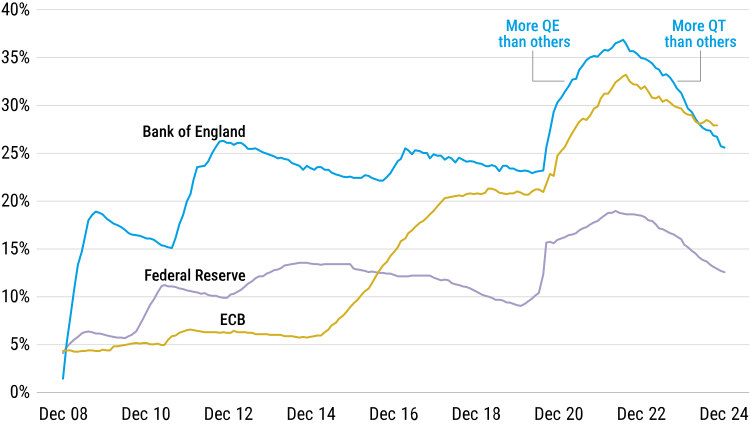
The global financial crisis of 2008 marked the turning point. With interest rates reduced to near-zero and credit markets frozen, central banks needed another method to stimulate their economies. As a result, major central banks began massive QE programmes. The Federal Reserve, Bank of England, and European Central Bank all began purchasing large quantities of government bonds, as well as some toxic assets like mortgage-backed securities, to restore confidence, drive down borrowing costs, and provide markets with some much-needed liquidity. Over the following years further QE became common and a staple method used by central banks.
The next big wave of QE came during the Covid-19 pandemic. Central banks injected trillions into economies across the globe through new asset purchase programmes, aiming to stabilise financial markets and keep government borrowing costs low. Balance sheets swelled to record highs, helping economies survive the period of uncertainty but also setting the stage for high post-pandemic inflation.
And as was expected, inflation surged across the globe after the pandemic. To tackle this, central banks introduced a new monetary policy method, Quantitative Tightening. This new era of QT signalled a cautious return to normality in monetary policy, as central banks began attempting to wind down their balance sheets to normal levels and stabilise the money supply.
Wrapping Up
Quantitative Policy has reshaped how modern central banks navigate and manage economic cycles. What began as an unconventional response to deflation in Japan has evolved into a defining feature of monetary policy. Through QE central banks have found a way to control the influence of the money supply, modifying borrowing costs and economic growth without touching interest rates. Through the introduction of QT, they now have a method to unwind that support, giving central banks another tool for battling inflation and keeping economies balanced.
So, next time the Bank of England or the Federal Reserve deliver their post-meeting announcements, listen out for any moves in Quantitative Policy. You’ll get a true insight into how they’re thinking and their real outlook for the economy.


